Investing in Mexico: Fideicomiso vs. Mexican Entity Explained
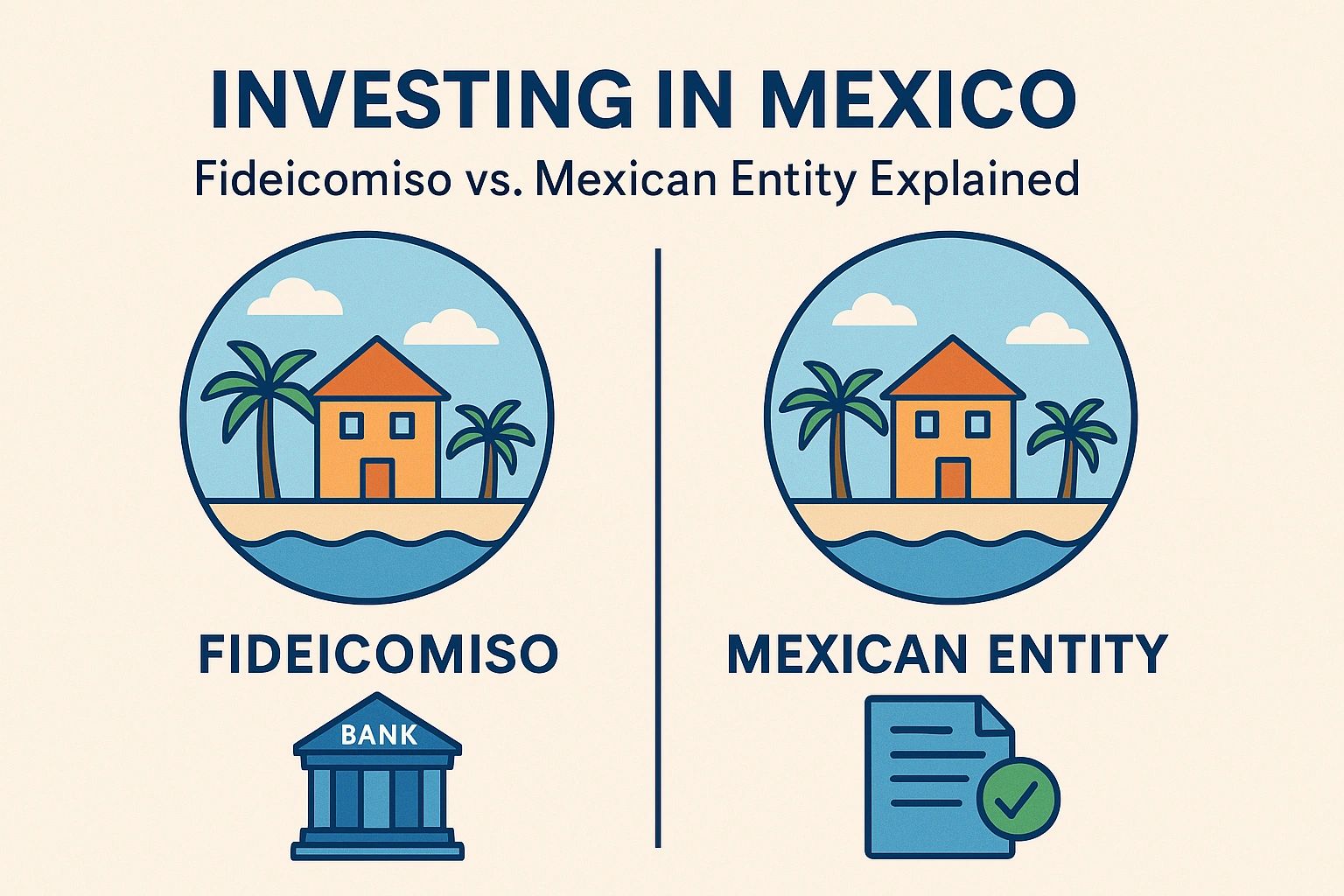
If you're a foreigner eyeing property near the beach in Mexico, you've likely been told you can't legally own it in your name. That's mostly true — but don't worry, there are legal vehicles that make it possible.
Let's break it down.
What Is the Restricted Zone?
Under Article 27 of the Mexican Constitution, foreigners cannot directly own land within 50 km (about 31 miles) of the coastline or 100 km (about 62 miles) of the borders. This area is known as the "Zona Restringida", or Restricted Zone — and it includes all of Mexico's prime beach real estate.
To make foreign investment possible, Mexico created two workarounds:
- Fideicomiso — a Mexican bank trust
- Mexican Entity — a corporation or limited liability company
Both can hold property in your favor — but the purpose, use, and tax consequences are different.
What Is a Fideicomiso?
A Fideicomiso is a trust-like arrangement set up with a Mexican bank. The bank holds legal title to the property, but you (the foreign investor) are the beneficiary, meaning you have full rights to use, lease, remodel, or sell it.
Typically used for:
- Vacation homes
- Passive investment property
- Residential purposes only
Not ideal for:
- Operating rental businesses
- Commercial use
- Multi-property portfolios
While similar to a U.S. trust, a Mexican Fideicomiso is not the same. It does not confer ownership in the same way and is governed under Mexican civil law, not trust law.
What Is a Mexican Entity?
A Mexican company — usually an S.A. de C.V. (corporation) or S. de R.L. (LLC-style) — is a fully Mexican legal entity that can directly own property anywhere in Mexico, including the restricted zone.
Best for:
- Airbnb rentals
- Multiple properties
- Real estate development
- Active business operations
It requires at least two members, must register with the Tax Administration Service (SAT), and must maintain monthly accounting and tax filings.
Key Legal and Tax Differences
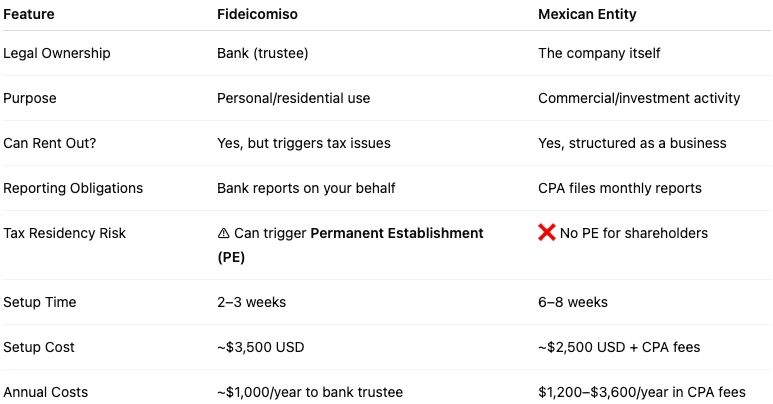
Setup time for a Mexican entity depends solely on the availability of appointments at SAT to obtain the tax ID (RFC) and register the entity.
What About Permanent Establishment (PE)?
Here's where things get serious. If you conduct economic activities (like short-term rentals) through a Fideicomiso, the SAT may deem that you — the foreign beneficiary — have a Permanent Establishment (PE) in Mexico.
A Permanent Establishment means that for tax purposes, Mexico considers you to be "doing business" in the country — personally.
What happens if you're deemed to have a PE?
- You may be personally liable for Mexican income tax on income derived from the property.
- You may be required to register with the SAT, obtain an RFC (tax ID), and file monthly and annual tax returns — even as an individual.
- Penalties, fines, and back taxes may apply for non-compliance.
- It may trigger reporting obligations in your home country (e.g., IRS in the U.S.) under cross-border information exchange agreements.
- You may fall under Mexican audit jurisdiction for any activity related to the property.
In contrast, owning and operating real estate through a Mexican entity generally shields you personally from PE risk — the company is the taxpayer, not you.
Which One Should You Choose?
If you're buying one home to use personally — and maybe rent occasionally — a Fideicomiso is a convenient solution.
But if you plan to:
- Manage rentals
- Operate an Airbnb or boutique hotel
- Buy and flip properties
- Hold multiple properties
→ You need a Mexican entity.
Final Thoughts
Foreigners can invest in Mexico — you just need to choose the right structure. A Fideicomiso is great for simplicity, but not for scaling or business. A Mexican entity takes more upkeep, but gives you control, compliance, and peace of mind.
This article is general information and is not legal or tax advice for any particular matter. Laws change and every situation differs. Speak to a professional before acting on it.